
Rand Fishkin and the folks over at SEOmoz have launched their inaugural podcast discussion how dominant online user-edited encyclopedia resource Wikipedia should be on Googles SERPs (search engine results pages).
Doing a search for “affiliate marketing” shows the Wiki entry at the top position for the organic results.
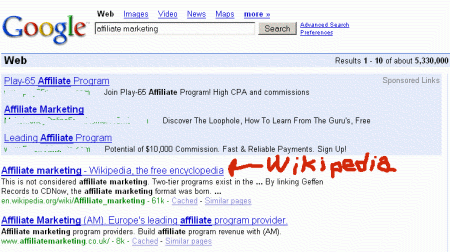
Should Wiki entries be so dominant? Especially as the members of the SEOmoz team point out other high authority sites might provide more comprehensive and relevant information?
As Shoemoney pointed out in his posts Google Video #1 Rank – What Kind Of Traffic Does It Bring? and Top Commentors MyblogLog Integration, the evolution of alternative high authority, high traffic sites like Google Video and MyBlogLog can bring huge amounts of traffic.
Now think about Wikipedia, which generates loads of traffic, coupled with it’s dominance at the SERPs. Can you imagine how a well-placed Wiki can drive hordes of qualified, focused traffic to a site?
A good podcast to kick off SEOmoz’s series (I believe they’re planning another 4).
I liked the content and it’s great to put a face to the team.
My feedback consists of two points:
- Tighter framing
I’m a fan of closely cropped photos and videos, which draw your eyes to the focus of attention. I’d probably have framed the shot like this:

- Publicly Hosted Bugbears
As with all hosted video services, the service will attempt to serve up relevant video content. At the end of this clip, the following “related” clips popped up:

While the “Shoe Shop prank” and “Mixed Armwrestling” clips might be irrelevant to Wikipedia and Google rankings, they could be good for a laugh.
Having “Cheating Wife” served up (even if it’s a joke clip), tends to detract from the informational nature of the clip.
The alternative would be to host the clips on a dedicated server, though the potential bandwidth resources would escalate exponentially, especially if the post ranks high on Digg and other services.
—
While you’re over at SEOmoz, you might like to check out Matt Inman and Rand’s Page Strength tool.

The purpose of the tool as listed is to:

I ran the tool on this domain and got the following summary:

Accompanying the summary is a comprehensive set of information, including dominance in the search engines, backlinks, link from .edu and .gov domains (I was surprised to see my blog listed at: Online gaming: Moral panic in Singapore), internal site links and others.
You can see the Page Strength results for WhoIsAndrewWee.com.
And the Page Strength tool can be found here.
In the works too are a variety of interesting SEO-related tools, I’m sure it’ll be worth checking out once they’re launched.
Hi Andrew,
Did you have a look at the Wikipedia article to affiliate marketing? Several affiliate marketers and other editors worked on the article for months and extended it more and more. Don’t you think that it is a good place to start to learn about affiliate marketing? Which single page on the web would you prefer over it?
It’s funny that you mentioned the Page Strength tool. My first post at ReveNews.com was about it. You might find it a useful read.
I am sorry that we did not meet at the Summit, but there were so much people, I even barely meet people with whom I wanted to talk a bit more before I got there. Well, next time 🙂
Carsten,
Thanks for your feedback.
If you read my post again, I wasn’t questioning the quality of information of the Wiki entry, but rather the dominance of wiki entries compared to other results.
Would the PageRank and corresponding SERP algorithmn give Wiki entries the same status accorded to .gov and .edu domains?
If so, then as Rand pointed out, should IMDB also have higher rankings, compared to Wikis?
I just find that it’s disturbing that the Wiki entries seem to dominant for several keywords and keyphrases. I’m sure you’ve had the experience of seeing entries where quality entries have been replaced by inferior entries containing hyperlinks by unscrupulous individuals attempting to game Wikipedia.
—
As for Page Strength, the composition of the score and corresponding breakdown of the backlinks and .gov and .edu links are equally or more instructional than the Page Strength aggregate score.
hey andrew, there is no proof that .gov or .edu domains are treated special. Meaning, if I would get an .edu domain today and build a site on top of it (new domain), would the simple fact that the domain ends with .edu not help me.
sites on .EDU and .GOV domains are usually authority sites, have a lot of good and/or relevant content and tons of inbound links and thus rank well. But the same is true for .com sites, such as wikipedia.
That crap in wikipedia ranks often higher than good content is because of the weight of the domain as a whole where the crap pages resides on is today a relevant ranking factor. There is a reason why SE do that, but it has obvious flaws as the wikipedia example shows.
Wikipedia is a good example, but not the only one.
IMDB ranks high already, higher than wikipedia, but for terms that are related to IMDB. Search for “clint eastwood” for example. IMDB is no.1, wikipedia 3 (if you discount the indented results) or “box office”. IMDB 5. and wikipedia nowhere to be found on page 1.
Good clarification.
Yes, .gov, .edu, .mil sites have quality content and would score better on that metric.
It’s be interesting to see if you did a series on domains and SEO implications at cumbrowski.com
The thing with that is that it is speculation. Some say it is the domain, others say what I said. It’s not very easy to prove, one way or the other, because goDaddy is currently out of mint fresh .gov and .edu domains for the general population 🙂
If the links come up too fast, your rankings will get de-indexed or sandboxed.
The bigger web traffic that niche already has, the
much more likely that you should be able to grab a portion of this traffic to your own site.
There are many companies that claim to give reasonable SEO hosting support services that
it becomes very hard to actually pick the precise and most competent
businesses for your webpage.
Howdy! I just wish to give a huge thumbs up
for the good info you may have right here on this post. I might be coming again to your blog for extra
soon.
Howdy! I simply would like to give an enormous thumbs
up for the good data you have got here on this post.
I can be coming again to your blog for more soon.
Hello! I just want to give a huge thumbs up for the nice
data you could have here on this post. I will be coming again to your blog for more soon.
The most likely abuser is just a spammer looking for
emails to use in a botnet. How often do you delete,
spam, or move emails into a specially titled folder from your inbox.
Their advantage is enabled by using the Internet to
perform all actions.
?Doskona?a optymalizacja strony pod katem wyszukiwarki i
marketing internetowy a Doskona?a optymalizacja strony
google and Internetowe nowoczesne pozycjonowanie stron bydgoszcz.
?Doskona?a optymalizacja strony pod katem wyszukiwarki i marketing internetowy a Doskona?a optymalizacja strony google
Komponowanie informacyjny Zawarto?? mo?e by? zabawy a mo?e i wyci?gn?? zainteresowane czytelników na swojej stronie internetowej gdzie mog? kupi? od was.
Wykorzystaj te wskazówki dla Twojej marketingu z art i prawdopodobnie b?dziesz zach?ci? j?cych
. Je?li jeste? wykszta?ceni z Online marketing Dojazd b?dziesz w stanie do wykorzystania artyku?y zawarto?? Aplikacje Zalet? .
I had been honored to receive a call from a friend immediately he uncovered the important ideas shared
on your site. Examining your blog write-up is a real brilliant experience.
Thanks again for thinking of readers like me, and I desire for you the best of achievements being a professional in this field.